Sinking Garage Floors on Fill: How Concrete Lifting Helps
We recently helped a homeowner with a garage slab sinking on 14 feet of fill. Here’s what causes sinking garage floors, the risks to watch for, and how concrete lifting can fix them.
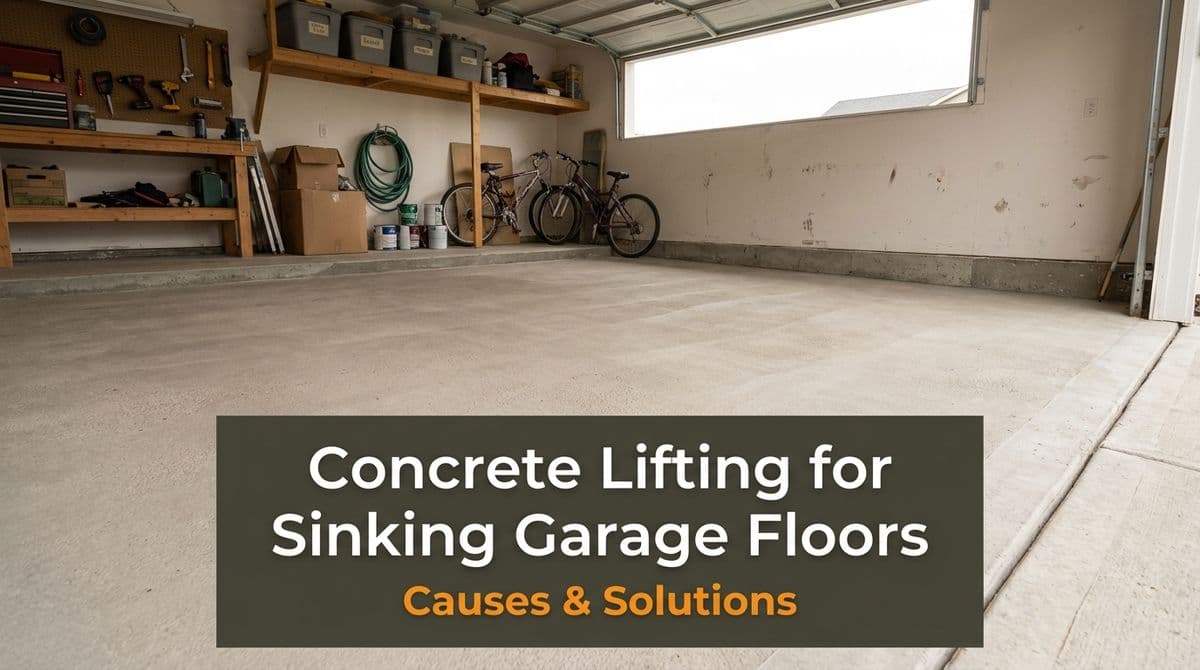
We recently got a call from a homeowner — let's call him Mark — who was worried about his attached garage. It was a big, 1,200-square-foot garage built back in 2006 on about 14 courses of block and a lot of sand fill. Over the last 20 years, the floor had started to sink.
Mark told us, “I’m pretty sure I’m parking on hollow concrete.” He’d tapped around the slab with a hammer and could hear the hollow spots. The worst area was right in the middle of the garage, with about a half-inch gap between the slab and the block wall in some spots. Outside, his apron had dropped a couple inches at one corner — what he called a “textbook settling apron.”
Why Garage Floors on Fill Start to Sink
Garages built on deep fill can be perfectly fine for years, but they’re more vulnerable to settlement. In Mark’s case, the garage foundation walls were on solid, undisturbed soil — that part was good. The issue was the 14 feet of sand fill brought in to bring the floor up to grade.
Even when contractors compact fill, a few things can still cause long-term settling and voids under the slab:
Natural consolidation over time – Loose or unevenly compacted areas compress slowly under the weight of vehicles.
Moisture and washing inside the garage – Mark mentioned he does washing in the garage. Water can migrate down through cracks and slab joints, carrying fine material away.
Drainage toward the garage – If the apron outside settles or slopes toward the garage, water can find its way under the slab.
Small gaps at walls or joints – Even a hairline gap is enough for water to sneak through repeatedly over the years.
Over time, this combination creates exactly what Mark suspected: an “empty hopper” or void under the slab, especially toward the middle where the weight is greatest.
Signs Your Garage Slab Is Sitting on a Void
One of the first things we ask homeowners — and what we asked Mark — is what they’re seeing and hearing. Common warning signs include:
Hollow sounds when you tap the floor with a hammer or even stomp your foot.
Noticeable gaps between the slab and the foundation wall, typically 1/4" to 1/2" or more.
Low spots or “bellies” where water puddles instead of draining toward the door.
Settled apron outside the garage, often dropping at the corner first.
Cracks widening over time, especially near the center of the slab.
In Mark’s garage, that half-inch of separation didn’t sound like much on paper, but on a smooth, finished garage floor it was very noticeable — and a clear sign the slab wasn’t fully supported.
Is a Sinking Garage Floor Dangerous?
We walked Mark through the risks, which apply to most sinking garage slabs:
Tripping hazards at transitions and cracks.
Stress on the concrete as unsupported areas flex and crack more easily.
Water problems if the floor no longer slopes correctly to the door or drain.
Impact on the house if movement transfers to adjoining walls or doors.
The good news for him — and for many homeowners — is that his structural foundation walls were on solid, original ground. The issue was the slab and the apron, both of which can typically be lifted and supported without replacing everything.
Mudjacking vs. Foam: What We Actually Pump Under Your Garage
Mark asked the same question we hear all the time: “Do you guys do mudjacking or foam?” We told him we don’t use foam, and we’re very particular about what goes under a slab — especially when it’s built on a lot of fill.
Here’s why and what we use instead:
No foam – Foam can be very strong, but it doesn’t address soil conditions and can behave differently with temperature and moisture over time.
No Clay based slurry– If your issue is already related to poor or expansive soils, we don’t want to add more reactive material.
Specially mixed material – We have our material blended specifically for lifting slabs. It’s a mix of sand and agricultural limestone (“Ag-lime”), which creates a stable, non-expansive base.
The goal isn’t just to push the slab up; it’s to fill the void completely so you’re not “parking on hollow concrete” anymore.
How Concrete Lifting Fixes a Sinking Garage Floor
Every project is a little different, but when we come out to a garage like Mark’s, the process typically looks like this:
Assessment and measuring – We map out high and low spots, tap for hollow areas, and check how the floor slopes.
Plan drill locations – We mark small holes (usually 5/8"–1") where material will be pumped under the slab.
Inject lifting material – Our slurry is pumped slowly, filling the voids and gently raising the slab back toward its original elevation.
Fine-tune and level – We watch the slab respond in real time, adding material where needed to support the entire area, not just one corner.
Patch and clean up – The drill holes are neatly patched, and once everything cures, you’re back in business.
For a big garage floor on fill, we’re not always trying to get it “laser perfect” to the millimeter, but we focus on removing trip hazards, restoring proper slope, and making sure the slab is fully supported.
What You Can Do If Your Garage Floor Is Settling
If your situation sounds like Mark’s, here are a few smart next steps:
Listen and look – Tap around for hollow spots and note cracks, gaps at the walls, and low areas where water sits.
Check your apron – A settled apron often goes hand-in-hand with a sinking garage slab.
Watch over time – Mark had been watching his for about three years and felt it had mostly stabilized; that’s helpful information for us.
Schedule an inspection – Photos are good, but nothing replaces getting eyes on the slab to see exactly what’s going on.
Mark called us during the off-season while he was home from work, which was perfect timing. Even if we can’t do the actual lifting work until warmer weather, we can still inspect, explain your options, and get you on the schedule so you’re not worrying about what you’re parking on.
If you’re concerned your garage floor is sinking on fill, you don’t have to guess what’s happening under the concrete. We’re happy to come out, take a look, and talk through whether concrete lifting is the right fix for your home.