Sinking Concrete Walkway? Causes, Risks & Repair Options
Dealing with a sinking concrete walkway? Learn what causes it, the risks to your home, and the best repair options, including professional lifting and leveling.
What To Do When Your Concrete Walkway Starts Sinking
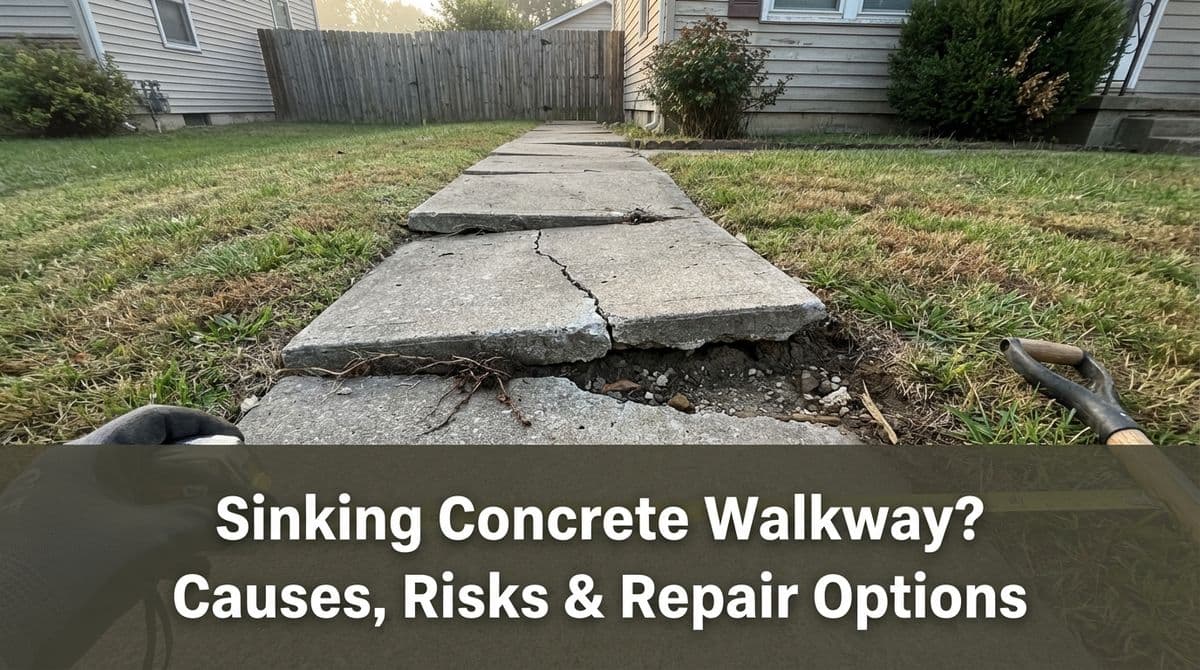
We recently got a call from a homeowner — let’s call her Emily — who noticed one section of her front concrete walkway had sunk. It was the last slab right before the step up to her porch, and it had dropped just enough to create an awkward little trip edge.
While she was outside looking at it, she also spotted a small area of cracking in the brick near a bay window and wondered if the two issues were related. She’d read on our website that we handle concrete lifting and brick pointing, so she called to have us take a look at both.
If you’re seeing something similar at your home — a sinking walkway, a step that’s no longer level, or gaps forming along your foundation — Emily’s situation is a perfect example of what to look for and what to do next.
Why Concrete Walkways Sink in the First Place
When we came out to Emily’s home, the first thing we did was look under the problem, not just at the surface. In almost every case, a sinking walkway is really a soil problem, not a concrete problem.
Common causes of sinking walkways
- Soil settlement: When a home is built, soil is often backfilled and doesn’t get compacted as tightly as the undisturbed ground. Over time, that loose soil compresses, and the concrete sitting on top begins to drop.
- Water washing soil away: Poor drainage, downspouts dumping next to the walk, or slopes toward the house can wash the supporting soil out from under the slab.
- Freeze-thaw movement: In colder climates, the ground freezes, lifts, and then settles again as it thaws. If the base under the walkway isn’t uniform, one section can move more than another and end up lower.
- Voids from organic material: Sometimes builders leave wood scraps or other debris under concrete. As that material decays, it leaves a void and the concrete drops into it.
In Emily’s case, we found a combination of mild settlement and water running toward that last slab near the porch. Fixing the concrete meant addressing both the support and the water.
Why a Sinking Walkway Is More Than Just an Eyesore
Many homeowners live with a sinking slab for years because “it doesn’t look that bad.” The problem is, the risks tend to grow quietly in the background.
Safety and liability concerns
- Trip hazards: Even a ½"–1" height difference between slabs is enough to catch a toe. That’s exactly what Emily was worried about with guests walking up to her porch.
- Ice and water pooling: Low spots collect water, which turns into ice in winter — another major slip risk.
- Visitor injuries: If a delivery driver, mail carrier, or guest trips on your walkway, you could be dealing with more than just repair costs.
Potential impact on your home
- Water toward the foundation: A sunken slab that slopes toward the house can push water against your foundation, increasing the chance of seepage or basement leaks.
- Stress on steps and porches: When the walkway drops, the step from the walkway to the porch becomes taller. That uneven transition can crack mortar and put stress on the porch structure over time.
- Property value: If you ever sell your home, inspectors and buyers will notice sinking concrete and cracks by the house. It’s a red flag that usually turns into a negotiation point.
Emily’s cracked brick under the bay window was minor, but it was smart of her to point it out while we were already on site. Little signs like that can be early warnings of movement.
Repair Options: Replace, Patch, or Lift?
When concrete sinks, homeowners usually think the only answer is tearing it out and starting over. That’s one option, but not always the best one.
Option 1: Full concrete replacement
Pros:
- Everything looks brand-new.
- Good choice if the slab is badly broken or crumbling.
Cons:
- Most expensive and disruptive option.
- Requires demolition, hauling away old concrete, forming, pouring, and curing.
- Doesn’t automatically solve the soil issue unless the contractor properly addresses the base.
Option 2: Patching or grinding
Some people try to “band-aid” the problem by grinding down the higher edge or troweling on patch material.
- Grinding can reduce a trip edge, but it won’t fix the underlying settlement or slope issues.
- Patching often cracks or flakes off because it’s a thin, weak layer on top of moving concrete.
We rarely recommend this except as a very short-term safety measure.
Concrete Lifting/Leveling: How It Works
For Emily’s walkway, lifting/leveling was the most practical and cost-effective solution. Instead of replacing the slab, we raised it back up to match the surrounding concrete and step height.
Typical lifting/leveling process
Depending on the method (traditional mudjacking or modern polyurethane foam), the basics are similar:
- Inspection and measurement
We measure how far the slab has dropped, check the condition of the concrete, and look for drainage issues, like downspouts or grading problems. - Drill small holes in the slab
Small holes are drilled through the concrete at strategic locations. These are later patched to blend in. - Inject lifting material
A specialized grout or foam is pumped under the slab. As it fills voids, it gently lifts the concrete back to the desired height. - Fine-tune and seal
We check the level, adjust if needed, then patch the drill holes and often seal joints to help keep water out.
Most walkway lifting jobs can be completed in a few hours, and you can typically walk on the surface the same day. For Emily, we also recommended redirecting a nearby downspout so she wouldn’t end up right back where she started.
What About Cracks in Nearby Brick or Foundation?
Emily also asked if the small cracked area under her bay window was serious. The answer: it depends, and it’s worth checking while we’re on site anyway.
When brick cracks are usually minor
- Hairline cracks in mortar only, not through the bricks.
- No pattern of wider cracks at the top or bottom of windows and doors.
- No signs of interior cracking in drywall or sticking doors nearby.
For these, we often recommend repointing: removing deteriorated mortar joints and replacing them with fresh mortar to protect the wall from further moisture and deterioration.
When to take cracks more seriously
- Diagonal cracks spreading from window or door corners.
- Gaps wide enough to fit a coin.
- Multiple cracks on different sides of the house.
Those can be signs of foundation settlement and should be evaluated along with any sinking concrete, drainage, and grading around the home.
When to Call a Pro (and What We Look For)
If you’re seeing any of the following, it’s time to have someone take a look:
- One or more walkway slabs are lower than the rest.
- You’ve got a noticeable “lip” at steps or the porch entry.
- Water is pooling against the house or at low spots.
- You notice new or growing cracks in brick or foundation walls.
When we come out, our process is simple: we walk the property with you (if you’re home), look at the concrete, check drainage and grading, note any cracks in nearby masonry, and then email you a written estimate. Just like with Emily, you don’t have to be home for us to inspect, but we’re always happy to talk it through if you are.
If your concrete walkway is starting to sink, addressing it now — with proper lifting/leveling and drainage fixes — will usually cost less and last longer than waiting until it’s a bigger trip hazard or a foundation concern.